Accessibility Tools

Sélectionnez votre langue

Sur le terrain

Explorez notre travail avec des partenaires, à l'échelle mondiale, pour lutter contre l'injustice sociale et économique sous l’angle des droits de l'Homme.

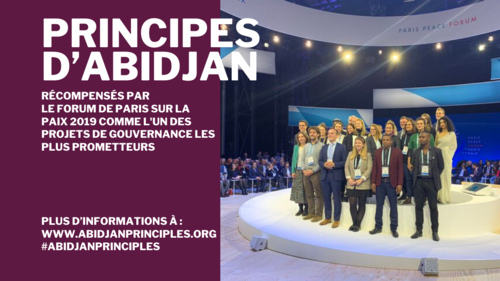
Les Principes d'Abidjan sur le droit à l'éducation récompensés par le Forum de Paris sur la Paix 2019 comme l'un des projets de gouvernance les plus prometteurs

Les Principes d'Abidjan sur le droit à l'éducation récompensés par le Forum de Paris sur la Paix 2019 comme l'un des projets de gouvernance les plus prometteurs

Les Principes d'Abidjan sur le droit à l'éducation récompensés par le Forum de Paris sur la Paix 2019 comme l'un des projets de gouvernance les plus prometteurs


(Paris, 14 novembre 2019) Le Forum de Paris sur la Paix a annoncé hier que les Principes d’Abidjan sur le droit à l’éducation avaient été sélectionnés comme l’un des dix ‘projets de gouvernance les plus prometteurs’, qui bénéficieront d’un soutien de passage à échelle. Les Principes d’Abidjan ont été sélectionnés parmi 716 projets provenant de 115 pays qui ont participé à l’appel à projets.

Cette sélection prestigieuse du Comité de suivi du Forum de Paris sur la Paix a été faite sur la base d’une série de critères, notamment la qualité du projet, son importance, et sa pertinence pour les questions de gouvernance mondiale actuelles.

La professeure Ann Skelton, présidente du Comité qui a rédigé les Principes d’Abidjan, a réagi : « C’est une reconnaissance importante de l’importance du droit à l’éducation et qu’avec des outils efficaces, le droit international des droits de l’Homme peut changer des vies. »

Selon Salima Namusobya, de l’organisation ougandaise, Initiative for Economic and Social Rights, « le prix vient renforcer la reconnaissance internationale grandissante des principes et constitue une nouvelle validation du travail effectué par des experts au cours des trois dernières années ».

Grâce à ce succès, les Principes d’Abidjan recevront une année de soutien sur mesure du Forum de Paris sur la Paix tout au long de 2020.

« Cette sélection contribuera à faire des Principes d'Abidjan un puissant outil de plaidoyer pour la réalisation du droit à l'éducation », a déclaré Rubeena Parker du Equal Education Law Center en Afrique du Sud.

Sylvain Aubry, de la Global Initiative for Economic, Social and Cultural Rights, a déclaré : « La reconnaissance de la valeur des Principes d'Abidjan par le Forum de Paris sur la Paix est une étape importante qui s'inscrit dans la dynamique croissante que nous avons connu ces derniers mois de remise du droit à l’éducation au cœur des débats sur l'éducation ».

‘Nous sommes impatients de travailler avec l’incroyable réseau de leaders avec lesquels le Forum de Paris sur la Paix collabore’, a réagi Delphine Dorsi, de l’Initiative pour le Droit à l’éducation.

‘Nous sommes pleinement déterminés à travailler sur les Principes d’Abidjan jusqu’à ce que le droit à l’éducation soit une réalité partout dans le monde et nous sommes très heureux du soutien que ceci pourra apporter’, a déclaré Solomon Sacco, d’Amnesty International.

Les Principes d’Abidjan sur les obligations des États en matière de droits de l’Homme de fournir un enseignement public et de réglementer la participation du secteur privé dans l’éducation ont été adoptés en février 2019 par plus de 50 experts éminents du droit à l'éducation. Ce texte historique détaille le droit international des droits de l'Homme en vigueur en ce qui concerne les obligations des États de fournir une éducation publique et de réglementer la participation du secteur privé à l'éducation. Ils sont en train de devenir rapidement l'un des principaux instruments de référence sur le droit à l'éducation, recevant l'aval des organisations de la société civile et la reconnaissance de nombreuses agences africaines et des Nations Unies.

Le Forum de Paris sur la Paix est un événement international annuel qui promeut des solutions innovantes pour faire face aux défis mondiaux.

Signataires :

  • Amnesty International

  • Equal Educational Law Centre

  • Global Initiative for Economic, Social and Cultural Rights

  • Initiative for Social and Economic Rights

  • Right to Education Initiative

Contacts :

  • Solomon Sacco (AN), Directeur adjoint, Law and Policy Programme, Amnesty International : Cette adresse e-mail est protégée contre les robots spammeurs. Vous devez activer le JavaScript pour la visualiser. Rubeena Parker (AN), Chef de la recherche, Equal Education Law Centre : Cette adresse e-mail est protégée contre les robots spammeurs. Vous devez activer le JavaScript pour la visualiser.

  • Sylvain Aubry (FR/AN), Conseiller juridique et politique, Global Initiative for Economic, Social and Cultural Rights : +254 7 88 28 96 34 / +33 7 81 70  81 96 / Cette adresse e-mail est protégée contre les robots spammeurs. Vous devez activer le JavaScript pour la visualiser.

  • Salima Namusobya (AN), Directrice exécutive, Initiative for Social and Economic Rights : Cette adresse e-mail est protégée contre les robots spammeurs. Vous devez activer le JavaScript pour la visualiser.

  • Delphine Dorsi (FR/AN/ES), Directrice, Right to Education Initiative :      Cette adresse e-mail est protégée contre les robots spammeurs. Vous devez activer le JavaScript pour la visualiser.

Related Articles

NEWSLETTER

Ne manquez aucune mise à jour!
Image

Sélectionnez votre langue

Social Media:

Log in

Climate and Environmental Justice

We have advanced rights-based and gender-transformative transition frameworks through research that centres the lived experiences of women and marginalised communities on the frontlines of extractive energy policies, promoting climate and energy frameworks attentive to the social and care-related impacts of transition pathways. We have developed a clear vision for a gender-just transition, firmly rooted in gender and human rights norms, establishing both the legal basis and the direction for the transformative changes our planet and societies urgently need. In particular, the ‘Guiding Principles for Gender Equality and Human Rights in the Energy Transition’, a collective effort built through online consultations, an in-person workshop and multiple rounds of revision with activists, practitioners and experts from around the world, outline a transformative vision for reshaping global energy systems through a human rights and gender equality lens.

Our work recognises that the climate emergency is both an existential threat and an opportunity to reimagine societies built on social, gender, economic and environmental justice. We ground our advocacy in feminist and intersectional principles, prioritising the agency and perspectives of communities in the Global South who have contributed the least to the climate emergency yet face its most devastating consequences. Central to our approach is the understanding that energy is not merely a commodity but a fundamental human right; essential for dignity, health, education, work and the realisation of countless other rights. We challenge approaches to the energy transition that risk replicating the harmful patterns of fossil fuel extraction and, instead, advocate for transformative policies that ensure human rights and gender equality as central to building climate-resilient societies rooted in dignity, justice and planetary well-being.

What's next?

We will continue to challenge approaches that treat energy transition as merely a technical shift, instead positioning it as an opportunity to reimagine economies and societies rooted in dignity for all, with particular attention to communities in the Global South who have contributed least to the climate emergency yet are most exposed to its worst effects.

We will connect community-level evidence and the lived experiences of those on the frontlines of extractive policies to national reform and global norm-setting, breaking down silos between human rights, gender, and climate movements, and advancing a shared vision that recognises just transitions as not only fundamental to achieving climate-resilient and sustainable societies, but as transformative pathways that advance social and gender equality, redistribute power and resources equitably, and ensure that energy systems serve the public good rather than profit.

We will mainstream rights-based and genderjust transition priorities in key multilateral spaces (particularly, within the Just Transition Work Programme and the to-be-developed Just Transition Mechanism, within the UNFCCC) to guarantee that just transitions are advanced at all levels.

We will also translate our work, through strategic advocacy, into at least two concrete policy wins, whether promoted, adopted, implemented, or scaled, in priority countries (Argentina, Brazil, Chile, Mexico, Colombia, South Africa, or Kenya), ensuring these policies align with human rights standards, centre gender equality, and reflect the needs and views of affected communities.

We will build momentum for the progressive recognition of the right to sustainable energy to shift dominant narratives away from purely extractive solutions that sideline gendered impacts, community participation, and Global South perspectives.

Economic Justice and Climate Finance

Our work has transformed the global discussion on fiscal policy in a more just, emancipatory and sustainable direction. Our approach has combined both high-level, expert contributions within decisionmaking circles, with bold, impactful work on narrative change with the general public.

We have been instrumental in the inclusion of human rights as a guiding principle of the future United Nations Framework Convention on International Tax Cooperation, a multilateral instrument with the potential of raising approx. USD 492 billion per year in public revenues currently foregone to global tax abuse. In the process leading to the ‘Compromiso de Sevilla’ decided at FfD4, we proposed and succeeded in creating a specific human rights workstream within the Civil Society Financing for Development Mechanism, which was critical to ensure that explicit commitments on the matter were included in the negotiating outcome. In a context of cutbacks in multilateral institutions, we have amplified the capacities of technical experts, providing rigorous technical support and leveraging our influence to ensure the enactments of groundbreaking standard-setting instruments, such as the 2025 UN Committee on Economic, Social and Cultural Rights Statement on Fiscal Policy and Human Rights, and the first ex oficio hearing on the Inter-American Commission of Human Rights on Fiscal and Economic Policies to Address Poverty and Structural Inequality, leading to an upcoming thematic resolution on the matter. We have also bridged the silos between multilateral tax discussions and climate finance debates, promoting ambitious financing commitments to increase international and domestic resource mobilisation during COP 28, 29 and 30.

At the regional level, our engagement with fiscal cooperation platforms such as the Platform for Fiscal Cooperation of Latin America and the Caribbean (PTLAC), where we are member of its Civil Society Consultative Council, and the African Anti-IFFs Policy Tracker, for which we participated in the pilot mission in Ivory Coast together with Tax Justice Network Africa (TJNA), have been critical in cementing a growing engagement between tax administrations and ministries of finance with international legal experts, exploring actionable and transformative initiatives, such as the taxation of high-net-worth individuals, beneficial ownership registries and corporate countryby-country reports, to be implemented at the international level.

At the local level, our interventions in fiscal reform debates in Chile, Brazil, Colombia and Nigeria have contributed to shaping legislative outcomes in a more progressive, rights-compliant direction.

As for our leadership in narrative change, we have a measurable track record in delivering tailored, innovative campaigns which have decisively expanded economic justice constituencies by appealing to a broader tent. In Latin America and the Caribbean, we created the ‘Date Cuenta’ campaign, coordinating over 40 organisations across civil society to deliver plain language, innovative messaging connecting progressive fiscal reforms to the financing of health, education and social protection. ‘Date Cuenta’ generated over 55 original campaign messages that were tailored to the realities of seven priority countries (Argentina, Chile, Colombia, Mexico, Paraguay, Peru and Honduras) and disseminated in Spanish, Portuguese and English. In doing so, we convened more than 65 online co-creation workshops with partners, coordinating a unified communications strategy which combined digital outreach, press and media coverage, and collaboration with influencers. Ultimately, ‘Date Cuenta’ resulted in more than 60,000 interactions on social media, coverage in major regional and international media outlets, including El País, Deutsche Welle, Bloomberg and France 24, and the participation of at least 63 social media influencers through 58 dedicated publications. In collaboration with Fundación Gabo and the Friedrich Ebert Stiftung, we also organised a two-day workshop in Bogota with 20 journalists from 13 countries, building a regional network trained in a human rights-based approach to fiscal policy that has since generated published media coverage on outlets such as La Diaria, Ciper, El Diario Ar and Milenio. Through ‘Date Cuenta’ and our regional advocacy, we strengthened civil society engagement in key processes, including the Financing for Development track and FfD4, co-organised highlevel dialogues with states and civil society from Latin America and Africa.

What's next?

We will shape the UN Tax Convention and its Protocols so they embed human rights principles, and we will stay engaged through follow-up processes (including the expected Conference of the Parties) to support effective implementation. We will keep linking tax and climate finance so that new resources mobilised through fiscal cooperation are channelled to adaptation, mitigation, and loss and damage, in line with UNFCCC commitments.

Public Services for Care Societies

We have translated participatory research into accountability and policy outcomes.

In Ivory Coast, our work with Mouvement Ivoirien des Droits Humains and affected communities since 2023 exposed how privatisation and lack of accountability restrict access to quality healthcare. It contributed to the closure of 1,022 illegal private health centres, an executive instrument strengthening the regulation of private hospitals across the country, and the creation of a permanent complaints management committee in healthcare through a bylaw issued by the prefect of Gagnoa. Partners engaged through this process also advanced concrete improvements at facility level: members of the Gagnoa Midwives Association who took part in the participatory action research pooled resources to renovate the neonatal unit of the Regional Hospital, and the Director of the Gagnoa General Hospital launched an action plan to expand services and improve patient reception, with the facility receiving the award for best hospital in the country in 2025.

In Kenya, our research with the Mathare Education Taskforce documented the absence of public schools and the expansion of private provision, evidencing impacts on households and caregivers and strengthening demands for free, quality public education. This work contributed to stronger community agency and collective organisation, alongside ongoing strategies ranging from communications to litigation to secure a public school in the area, some involving GI-ESCR and others led independently.

Across Africa, this work is complemented by a multi-country study examining the human rights implications of austerity in education and health, including how regressive fiscal policies, rising debt burdens and persistent underinvestment undermine the financing and delivery of public services.

In Latin America, from 29 November to 2 December 2021, over a thousand representatives from over one hundred countries, from grassroots movements, advocacy, human rights, and development organisations, feminist movements, trade unions, and other civil society organisations, met in Santiago, Chile, and virtually, to discuss the critical role of public services for our future. Following the meeting, the Santiago Declaration on Public Services was adopted to demand universal access to quality, gender-transformative and equitable public services as the foundation of a fair and just society.

We are currently advancing work on care systems, linking public services and fiscal justice through integrated research, advocacy and communications, including a regional campaign framing care as a collective responsibility requiring sustained public investment.

What's next?

In Ivory Coast, we will evaluate and strengthen the complaints management committee and position it as a replicable model for other health facilities. In Kenya, we will support the Mathare community to co-design a model public school for Mabatini and Ngei wards, grounded in human rights standards. Building on our multi-country austerity study, we will drive national advocacy on financing for education and health: advancing reforms in Ghana; launching a fiscal policy and public services financing agenda in Kenya through the CESCR process and targeted coalition work; and, in Nigeria, using the new tax acts in force since 1 January 2026 to catalyse a national accountability campaign for adequately funded, quality public services. In Latin America, we will amplify locally led care pilots across 8 countries and turn lessons into influence—advancing care policies that strengthen care organisations, protect care workers’ rights, support unpaid caregivers, include disability and family networks, and redistribute care more equitably.