

Les informations ci-dessous sont principalement en anglais, veuillez défiler vers le bas pour une liste de ressources disponibles en français.
La información que figura a continuación está principalmente en inglés. Al final de la página encontrarás una lista de recursos disponibles en español.
La información que figura a continuación está principalmente en inglés. Al final de la página encontrarás una lista de recursos disponibles en español.
Dear Abidjan Principles,
We hope you have been doing well since our latest update.
Today we are celebrating the fourth anniversary of the Abidjan Principles!
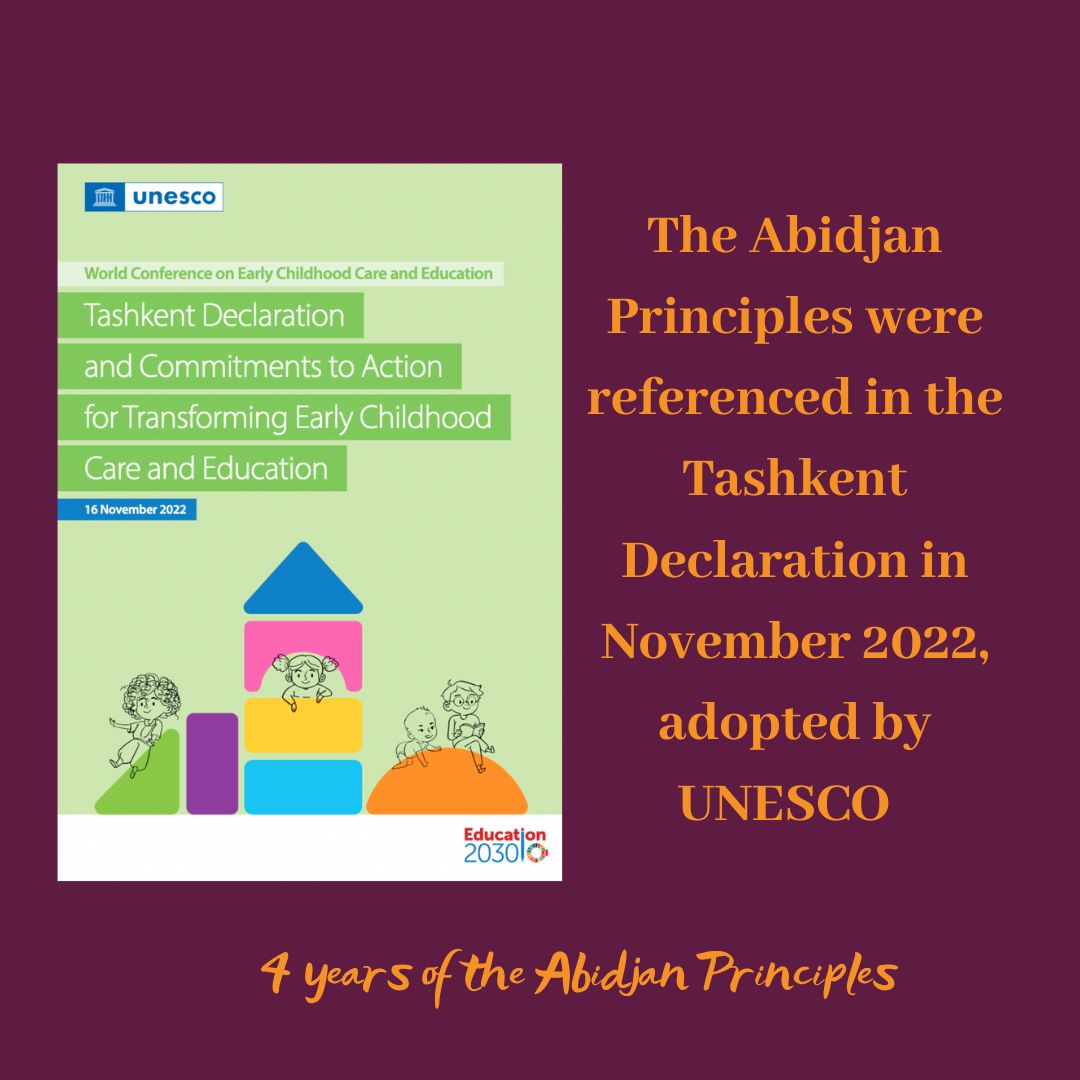
In just four years, the Principles have been recognised by more than 10 human rights bodies and legal institutions. They were also recently referenced in the Tashkent Declaration, which was adopted at the UNESCO World Conference on Early Childhood Care and Education in November 2022.
To date, the Abidjan Principles have been used for research, advocacy and litigation by various actors across South America, Africa, Europe and Asia. In addition to resources that can be found on the website, the book ‘Realizing the Abidjan Principles on the Right to Education’ was published in 2021. The book is openly accessible and was released alongside a series of videos featuring the contributing authors summarising their chapters.
Below is an overview of some key developments since June 2022, as well as upcoming events for the months ahead.
For more information, follow developments on the Abidjan Principles website, and on Twitter via the hashtag #AbidjanPrinciples
We hope you have been doing well since our latest update.
Today we are celebrating the fourth anniversary of the Abidjan Principles!
In just four years, the Principles have been recognised by more than 10 human rights bodies and legal institutions. They were also recently referenced in the Tashkent Declaration, which was adopted at the UNESCO World Conference on Early Childhood Care and Education in November 2022.
To date, the Abidjan Principles have been used for research, advocacy and litigation by various actors across South America, Africa, Europe and Asia. In addition to resources that can be found on the website, the book ‘Realizing the Abidjan Principles on the Right to Education’ was published in 2021. The book is openly accessible and was released alongside a series of videos featuring the contributing authors summarising their chapters.
Below is an overview of some key developments since June 2022, as well as upcoming events for the months ahead.
For more information, follow developments on the Abidjan Principles website, and on Twitter via the hashtag #AbidjanPrinciples
Fourth Anniversary of the Abidjan Principles!
Below are some of the images used in our four-day countdown to this 4th Anniversary. Please join us in celebrating some of the APs achievements by posting on your own social media accounts!
Join us: #AbidjanPrinciples
Join us: #AbidjanPrinciples

July 2022
Webinar presenting the report on privatisation and commercialisation of education in Senegal by La Coalition Des Organisations en Synergie pour la Défense de l'Éducation Publique (COSYDEP), mobilizing the Abidjan Principles.
Presentation on the Abidjan Principles at an advocacy workshop by the Mouvement Ivoirien des Droits Humains (MIDH).
September 2022
Blog post emphasising the problems with standardization recommends that defenders of education as a human right should focus on upholding standards, particularly national minimum standards and human rights, as outlined in the Abidjan Principles. The blog builds on a joint statement from civil society organisations on the IFC’s divestment from Bridge International Academies (BIA).
October 2022
Global Initiative for Economic Social & Cultural Rights (GI-ESCR), Institute for Social & Economic Research (ISER) Uganda, the Center for Human Rights, Dullah Omar Institute and the Right to Education Initiative contribute to the drafting of the African Commission on Human and People’s Rights, General Comment 7. The general comment cites the Abidjan Principles in its outline of state obligations under the African Charter on Human and Peoples’ Rights regarding private provision of social services.
Global Initiative for Economic, Social and Cultural Rights (GI-ESCR) prepares three briefs presenting essential information regarding the Principles. These can be used as a reference point for governments, educators and education providers in debates about the respective roles and duties of States and private actors in education.
Second edition of the University of Geneva course launched. The University of Geneva, the Global Initiative for Economic, Social and Cultural Rights, the Right to Education Initiative and the Réseau de Recherche Francophone sur la Privatisation de l'Education and eduCoop invite applications from national civil society organisations in French-speaking countries to take part in the second edition of the training course "Research capacity towards advocacy for the right to education". The course applies the Abidjan Principles as part of the international framework on the right to education.
Tribune Jeunes Pour le Droit au Mali (TRIJEUD-Mali) participates in the first edition of the University of Geneva course on research capacity towards advocacy for the right to education. The prize for Best Report was awarded to TRIJEUD-Mali. Their report mobilized the Abidjan Principles focusing on "Working conditions of primary school teachers in private schools in Mali: the case of Commune III in the district of Bamako, from 2016 to 2022". The award provided support in implementing the organisation’s advocacy plan related to its report.
“The Abidjan Principles in Practice”: a group of CSOs and academics held a learning session to provide a space for knowledge and experience sharing.
November 2022
Mercedes Mayol Lassalle, the World President of World Organisation for Early Childhood Education (OMEP), mentions the Abidjan Principles in her speech at the UNESCO World Conference on Early Childhood Care and Education, stating ‘The Abidjan Principles on the Right to Education provide guidelines for States to define the public service obligations on non-state actors involved in education…’.
Tashkent Declaration on Early Childhood Care and Education references the Abidjan Principles. The Tashkent Declaration and Commitments to Action for Transforming Early Childhood Care and Education was adopted at the World Conference on Early Childhood Care and Education. In a list of “pioneering international and regional initiatives”, the declaration expressly refers to the Abidjan Principles to demonstrate the human rights obligations of States to provide public education and regulate private involvement in education.
Coalition Education attended the Paris Peace Forum High Level Round Table on “Innovative Financing for Education: How to take action?” alongside the Minister of Education of the Republic of Bangladesh, the Ambassador of Rwanda to France, UNICEF, the OECD and KOIS Invest. The Principles were referred to when discussing issues related to the privatisation of education. Watch the event here.
January 2023
Joint contribution to the Special Rapporteur on the Right to Education for her thematic report to the Human Rights Council coming in June 2023. In the joint submission, the Abidjan Principles are referenced as key to securing the right to education globally.
The Global Initiative for Economic, Social and Cultural Rights and its partner Mouvement Ivoirien des Droits Humains organise an online event to present their advocacy strategy based on the recommendations of their joint report on the impact of the privatisation and commercialisation of education in Côte d’Ivoire in light of the Abidjan Principles.
Webinar presenting the report on privatisation and commercialisation of education in Senegal by La Coalition Des Organisations en Synergie pour la Défense de l'Éducation Publique (COSYDEP), mobilizing the Abidjan Principles.
Presentation on the Abidjan Principles at an advocacy workshop by the Mouvement Ivoirien des Droits Humains (MIDH).
September 2022
Blog post emphasising the problems with standardization recommends that defenders of education as a human right should focus on upholding standards, particularly national minimum standards and human rights, as outlined in the Abidjan Principles. The blog builds on a joint statement from civil society organisations on the IFC’s divestment from Bridge International Academies (BIA).
October 2022
Global Initiative for Economic Social & Cultural Rights (GI-ESCR), Institute for Social & Economic Research (ISER) Uganda, the Center for Human Rights, Dullah Omar Institute and the Right to Education Initiative contribute to the drafting of the African Commission on Human and People’s Rights, General Comment 7. The general comment cites the Abidjan Principles in its outline of state obligations under the African Charter on Human and Peoples’ Rights regarding private provision of social services.
Global Initiative for Economic, Social and Cultural Rights (GI-ESCR) prepares three briefs presenting essential information regarding the Principles. These can be used as a reference point for governments, educators and education providers in debates about the respective roles and duties of States and private actors in education.
Second edition of the University of Geneva course launched. The University of Geneva, the Global Initiative for Economic, Social and Cultural Rights, the Right to Education Initiative and the Réseau de Recherche Francophone sur la Privatisation de l'Education and eduCoop invite applications from national civil society organisations in French-speaking countries to take part in the second edition of the training course "Research capacity towards advocacy for the right to education". The course applies the Abidjan Principles as part of the international framework on the right to education.
Tribune Jeunes Pour le Droit au Mali (TRIJEUD-Mali) participates in the first edition of the University of Geneva course on research capacity towards advocacy for the right to education. The prize for Best Report was awarded to TRIJEUD-Mali. Their report mobilized the Abidjan Principles focusing on "Working conditions of primary school teachers in private schools in Mali: the case of Commune III in the district of Bamako, from 2016 to 2022". The award provided support in implementing the organisation’s advocacy plan related to its report.
“The Abidjan Principles in Practice”: a group of CSOs and academics held a learning session to provide a space for knowledge and experience sharing.
November 2022
Mercedes Mayol Lassalle, the World President of World Organisation for Early Childhood Education (OMEP), mentions the Abidjan Principles in her speech at the UNESCO World Conference on Early Childhood Care and Education, stating ‘The Abidjan Principles on the Right to Education provide guidelines for States to define the public service obligations on non-state actors involved in education…’.
Tashkent Declaration on Early Childhood Care and Education references the Abidjan Principles. The Tashkent Declaration and Commitments to Action for Transforming Early Childhood Care and Education was adopted at the World Conference on Early Childhood Care and Education. In a list of “pioneering international and regional initiatives”, the declaration expressly refers to the Abidjan Principles to demonstrate the human rights obligations of States to provide public education and regulate private involvement in education.
Coalition Education attended the Paris Peace Forum High Level Round Table on “Innovative Financing for Education: How to take action?” alongside the Minister of Education of the Republic of Bangladesh, the Ambassador of Rwanda to France, UNICEF, the OECD and KOIS Invest. The Principles were referred to when discussing issues related to the privatisation of education. Watch the event here.
January 2023
Joint contribution to the Special Rapporteur on the Right to Education for her thematic report to the Human Rights Council coming in June 2023. In the joint submission, the Abidjan Principles are referenced as key to securing the right to education globally.
The Global Initiative for Economic, Social and Cultural Rights and its partner Mouvement Ivoirien des Droits Humains organise an online event to present their advocacy strategy based on the recommendations of their joint report on the impact of the privatisation and commercialisation of education in Côte d’Ivoire in light of the Abidjan Principles.

September 2022
Ghana National Education Coalition makes news with capacity-building sessions on the Abidjan Principles for stakeholders held in Accra. The Coalition brought together members and media stakeholders to equip them with knowledge and understanding of how to advocate for greater responsiveness from governments using the Abidjan Principles as a framework.
November 2022
Article calls on the Kenyan government to find "more creative ways of funding education", and mentions the Abidjan Principles as a reference point.
Ghana National Education Coalition makes news with capacity-building sessions on the Abidjan Principles for stakeholders held in Accra. The Coalition brought together members and media stakeholders to equip them with knowledge and understanding of how to advocate for greater responsiveness from governments using the Abidjan Principles as a framework.
November 2022
Article calls on the Kenyan government to find "more creative ways of funding education", and mentions the Abidjan Principles as a reference point.

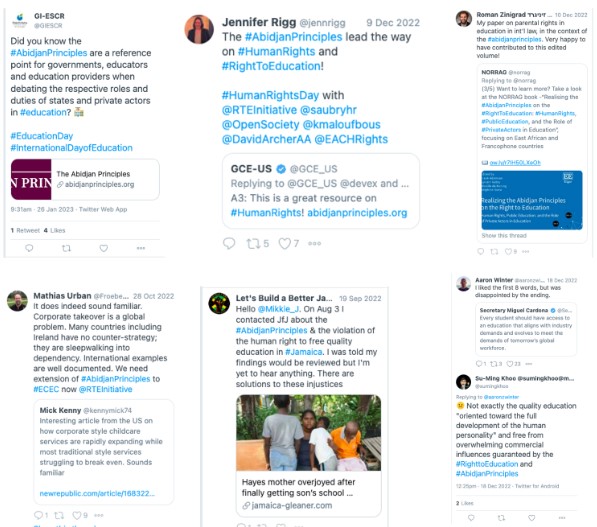
Below is a selection of screen grabs from the previous months displaying some of the interactions with the Principles.

The Abidjan Principles are increasingly being used in academic literature and by researchers, demonstrating both their validity as a reference document on the right to education and the extent to which awareness of this fundamental text is spreading across academic disciplines and geographical regions. Below is a selection of recent publications.
May 2022
New scientific article on early childhood financing in Brazil in light of the Abidjan Principles, by Andressa Pellanda (University of São Paulo) and Koumbou Boly Barry (UN & ICESCO).
June 2022
Adrian Zancajo, Antoni Verger, and Clara Fondevila publish a paper entitled ‘Education privatization: Expanding spaces and new global regulatory trends in educational privatization’.
Toward Understanding the Global Landscape of Educational Pluralism. This paper explores the global and cross-national landscape of educational pluralism, its grounding in human rights law and contemporary debates, and how it might be measured cross-nationally.
November 2022
New academic article: Why neoliberal ideology, privatisation, and other challenges make a reframing of the right to education in international law necessary, Klaus D. Beiter, Faculty of Law, North-West University, Potchefstroom, South Africa.
January 2023
New book published this year, Shadow education in the Middle East: Private supplementary tutoring and its policy implications by Mark Bray & Anas Hajar.
New journal article (open access), titled The business of development: The institutional rationales of technology corporations in educational development, by Lara Patil. This paper analyses the institutional rationales of transnational technology corporations in the USA to test a tentative theory of transnational technology corporations’ engagement in educational development.
May 2022
New scientific article on early childhood financing in Brazil in light of the Abidjan Principles, by Andressa Pellanda (University of São Paulo) and Koumbou Boly Barry (UN & ICESCO).
June 2022
Adrian Zancajo, Antoni Verger, and Clara Fondevila publish a paper entitled ‘Education privatization: Expanding spaces and new global regulatory trends in educational privatization’.
Toward Understanding the Global Landscape of Educational Pluralism. This paper explores the global and cross-national landscape of educational pluralism, its grounding in human rights law and contemporary debates, and how it might be measured cross-nationally.
November 2022
New academic article: Why neoliberal ideology, privatisation, and other challenges make a reframing of the right to education in international law necessary, Klaus D. Beiter, Faculty of Law, North-West University, Potchefstroom, South Africa.
January 2023
New book published this year, Shadow education in the Middle East: Private supplementary tutoring and its policy implications by Mark Bray & Anas Hajar.
New journal article (open access), titled The business of development: The institutional rationales of technology corporations in educational development, by Lara Patil. This paper analyses the institutional rationales of transnational technology corporations in the USA to test a tentative theory of transnational technology corporations’ engagement in educational development.
New Thematic Report Building and Strengthening the Legal Framework on ECCE Rights, Achievements, Challenges and Actions for Change, published in the context of the World Conference on Early Childhood Education and Care 2022 as a the result of a fruitful collaboration between UNESCO, the Right to Education Initiative (RTE), Human Rights Watch (HRW), the World Organization for Early Childhood Education (OMEP), the Oxford Human Rights Hub (Oxford University), the UN Special Rapporteur on the right to education (OHCHR), and the Latin American Campaign for the Right to education (CLADE).
April 2022
Plataforma en Defensa de la Escuela Pública Vasca (EEPAP), Basque country: The Abidjan Principles were one of the main arguments in an Open Letter to the Basque Parliament on the New Education Act. In the letter, the Platform for the Defense of the Basque Public School argues that the New Education Act leaves public schools in an even less favourable situation than at present and does not seriously address the pressing issue of school segregation. Furthermore, the new act strengthens the standing of publicly-funded but privately-run schools, which make up almost half of the educational system, and are a key cause of school segregation. The Abidjan Principles were then presented to the Education Commission of the Basque Parliament. Videos of the hearing are available here.
May 2022
The Brazilian Campaign for the Right to Education recently published a scientific article regarding early childhood education (ECE) financing in Brazil in light of Abidjan Principles. Summary: ECE is the stage of education most affected by the increase in funding but the new Fund (Fundeb) continues to encourage Public Private Partnerships without regulations. This article analyses the Constitutional Amendment 108 of Fundeb, and its regulatory and advisory legislation based on the Abidjan Principles.
June 2022
Asociación Civil por la Igualdad y la Justicia (ACIJ), Argentina: Class action against the Government of the City of Buenos Aires regarding its omission to control, monitor and sanction private schools that discriminate against students with disabilities within the enrollment process reached a favourable ruling. The legal arguments in the case introduce the Abidjan Principles as core obligations of the local State regarding inclusive education.
September 2022
International Commission of Jurists (ICJ), Nepal: organize a judicial dialogue with judges of Nepal’s High Courts on right to education and discussed the relevance of the Abidjan Principles (APs) in regulating private education providers. As an expert invited to speak in the dialogue, the Supreme Court Justice Hari Prasad Phuyal made a presentation on the APs and underscored their usefulness to hold private educational institutions accountable. He also highlighted the fact that judges could refer to such international principles and standards in areas of human rights and public education.
January 2023
Mouvement Ivoirien des Droits Humains, Côte d'Ivoire, presented its advocacy strategy around four pillars for the implementation of the 2022 report. One of the pillars is to advocate the harmonisation of national laws by mainstreaming the Abidjan Principles.
February 2023
International Commission of Jurists (ICJ), Nepal: Following the lines of thought expressed in the 2022 judicial dialogue (see above), recently Justice Phuyal, along with another Supreme Court Justice, Ishwor Prasad Khatiwada made a judgement referring to the Abidjan Principles (such as 4, 7 and 8) stating that private educational institutions cannot escape from the general standards of operations set by the state, and in case of failure to do so, the state has a right to cancel their registration. This is the first time that the APs have been cited in a judgement by Nepal’s judiciary.
Bulletin d'information en français
Nous célébrons aujourd’hui le quatrième anniversaire des Principes d’Abidjan !
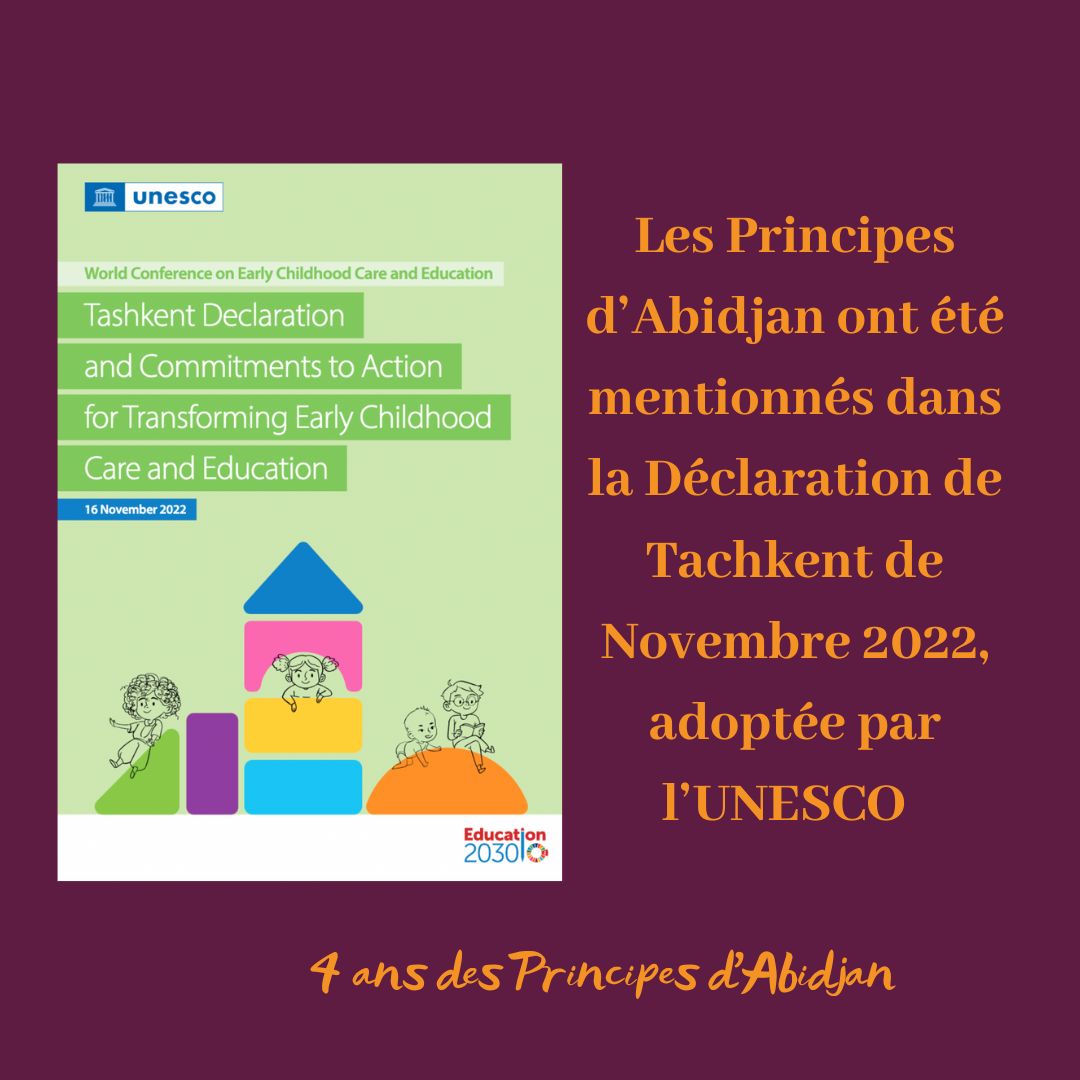
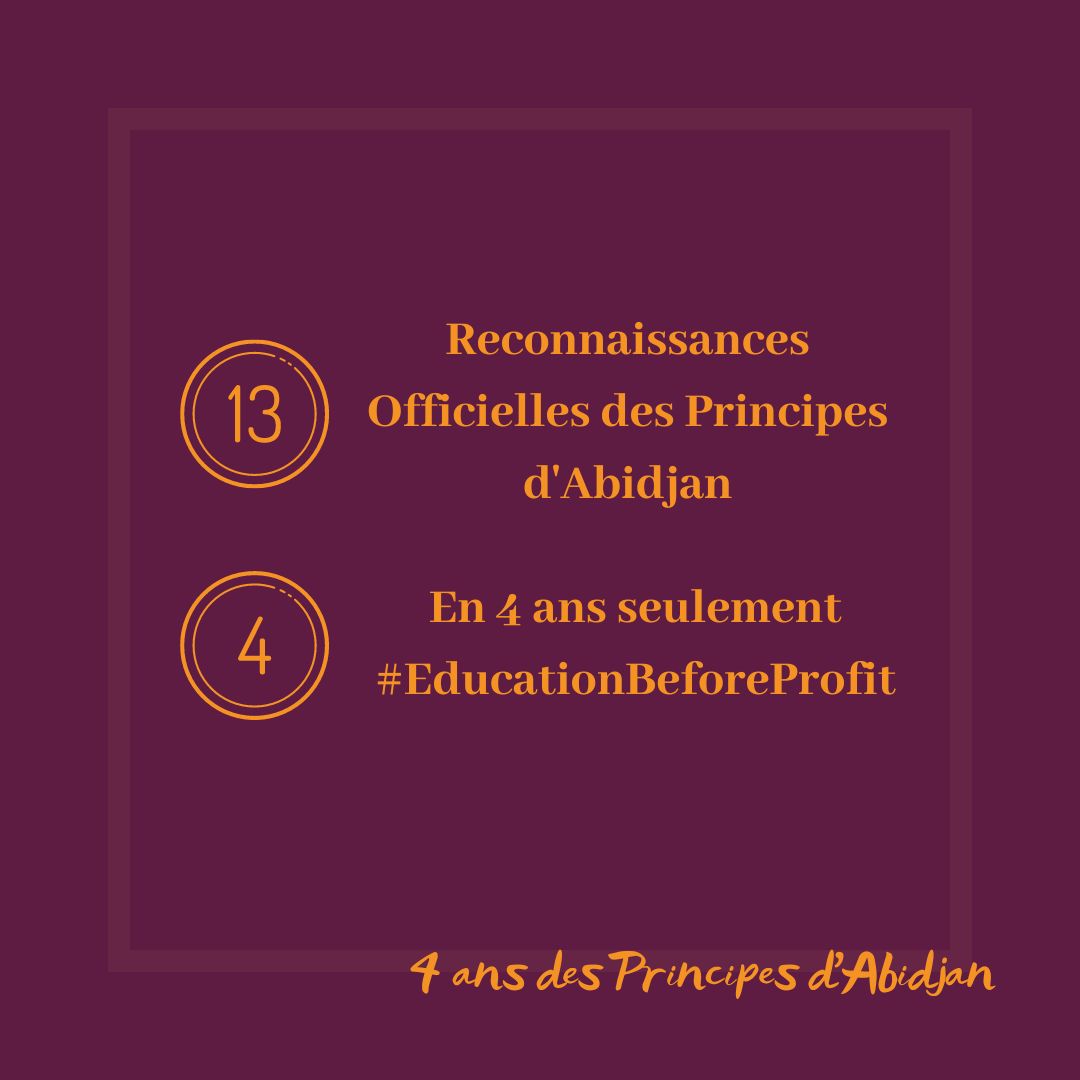
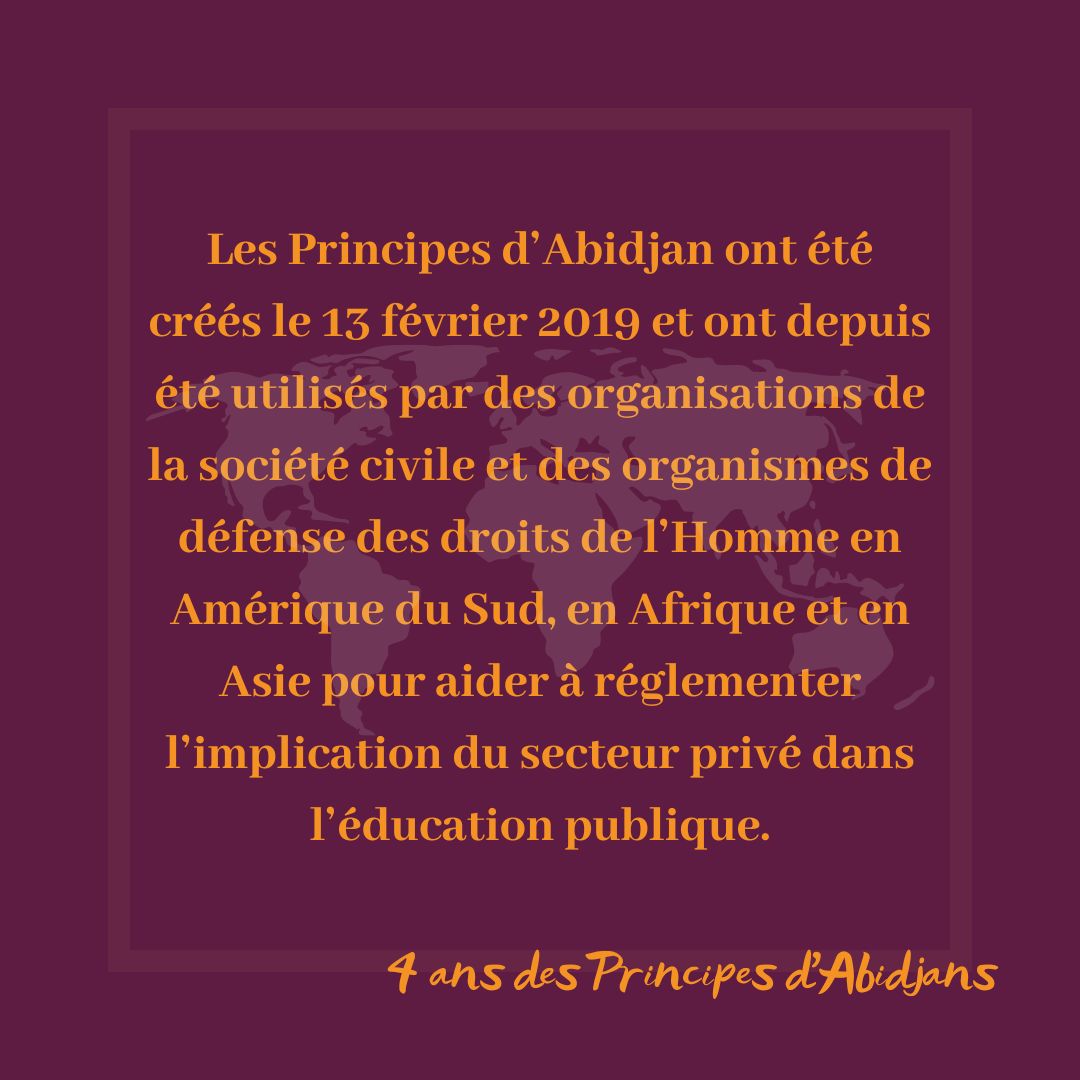
En seulement quatre ans, les Principes d’Abidjan ont déjà été reconnus par plus de dix organismes de défense des droits de l’Homme et des institutions juridiques. Ils ont également été récemment mentionnés dans la Déclaration de Tachkent adoptée à la Conférence mondiale de l’UNESCO sur l'Éducation et la Protection de la Petite Enfance (Novembre 2022).
À ce jour, les Principes d’Abidjan ont été utilisés pour la recherche, le plaidoyer et le contentieux par divers acteurs d’Amérique du Sud, d’Afrique et d’Asie. En plus des ressources disponibles sur le site internet, le livre Réaliser les Principes d’Abidjan sur le droit à l’éducation a été publié en 2021, en accès libre. Les auteurs ont aussi résumé leurs chapitres dans une série de vidéos.
Vous trouverez ci-dessous un aperçu des moments clés depuis juin 2022, ainsi que des événements à venir dans les prochains mois.
4ème anniversaire
Notre compte à rebours des quatres derniers jours a été amplement partagé sur Instagram et Twitter. Ci-dessous, vous retrouverez les images utilisées pour le célébrer. Rejoignez-nous pour célébrer les réussites des Principes d’Abidjan en partageant ces messages sur vos réseaux sociaux!
Rejoignez-nous avec #AbidjanPrinciples
En seulement quatre ans, les Principes d’Abidjan ont déjà été reconnus par plus de dix organismes de défense des droits de l’Homme et des institutions juridiques. Ils ont également été récemment mentionnés dans la Déclaration de Tachkent adoptée à la Conférence mondiale de l’UNESCO sur l'Éducation et la Protection de la Petite Enfance (Novembre 2022).
À ce jour, les Principes d’Abidjan ont été utilisés pour la recherche, le plaidoyer et le contentieux par divers acteurs d’Amérique du Sud, d’Afrique et d’Asie. En plus des ressources disponibles sur le site internet, le livre Réaliser les Principes d’Abidjan sur le droit à l’éducation a été publié en 2021, en accès libre. Les auteurs ont aussi résumé leurs chapitres dans une série de vidéos.
Vous trouverez ci-dessous un aperçu des moments clés depuis juin 2022, ainsi que des événements à venir dans les prochains mois.
4ème anniversaire
Notre compte à rebours des quatres derniers jours a été amplement partagé sur Instagram et Twitter. Ci-dessous, vous retrouverez les images utilisées pour le célébrer. Rejoignez-nous pour célébrer les réussites des Principes d’Abidjan en partageant ces messages sur vos réseaux sociaux!
Rejoignez-nous avec #AbidjanPrinciples

Plus d’informations en français:
- Le site officiel
- Le texte officiel
- Une série de vidéos expliquant ce que sont les Principes d'Abidjan
- Résumé d'un chapitre du livre: Réaliser les Principes d’Abidjan sur le droit à l’éducation
- Mme Koumba Boly Barry, Rapporteuse spéciale sur le droit à l’éducation explique comment utiliser les Principes d'Abidjan
- Vidéo sur le droit à l'éducation (sous-titres disponibles en français)
Boletín en español
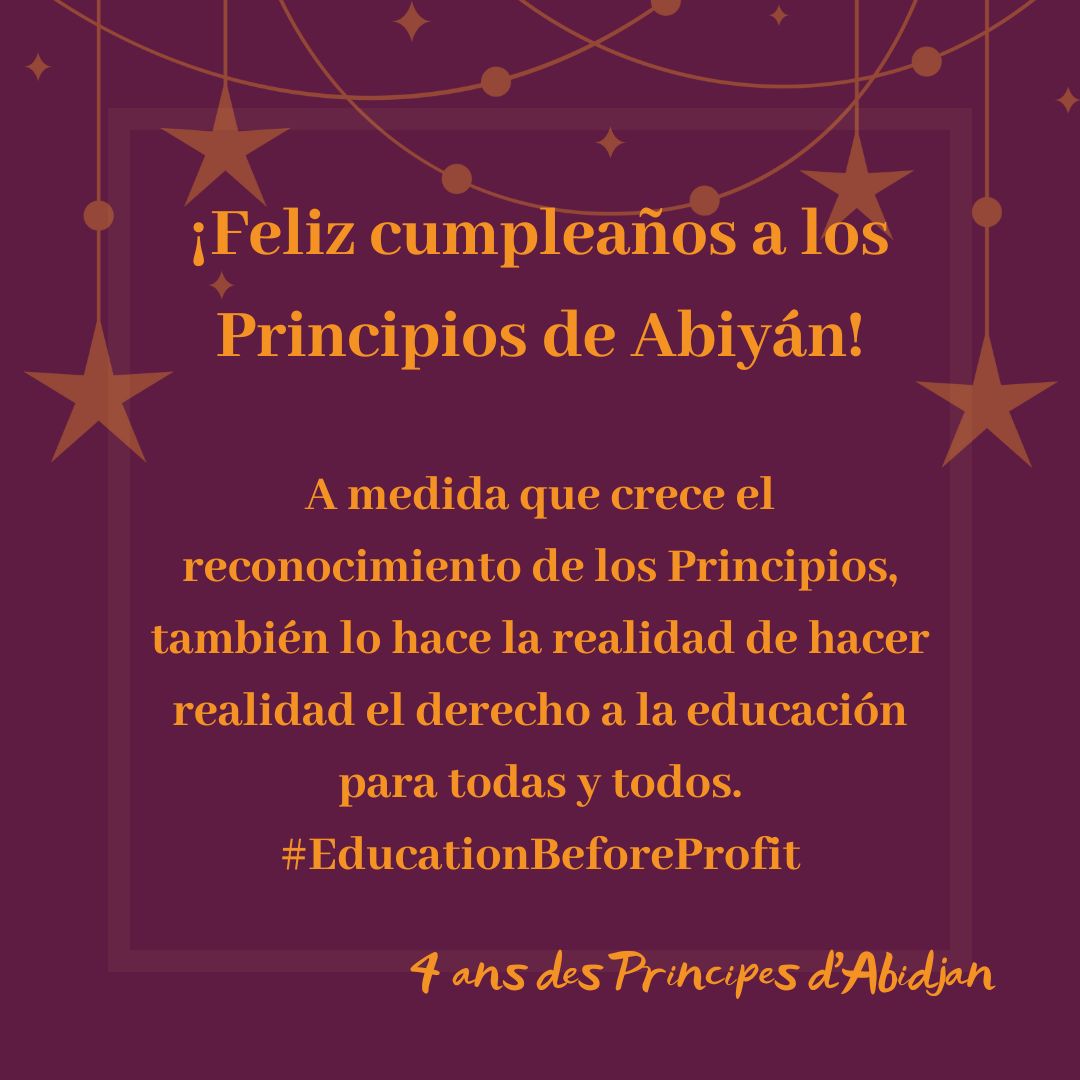
Hoy celebramos el cuarto aniversario de los Principios de Abiyán!
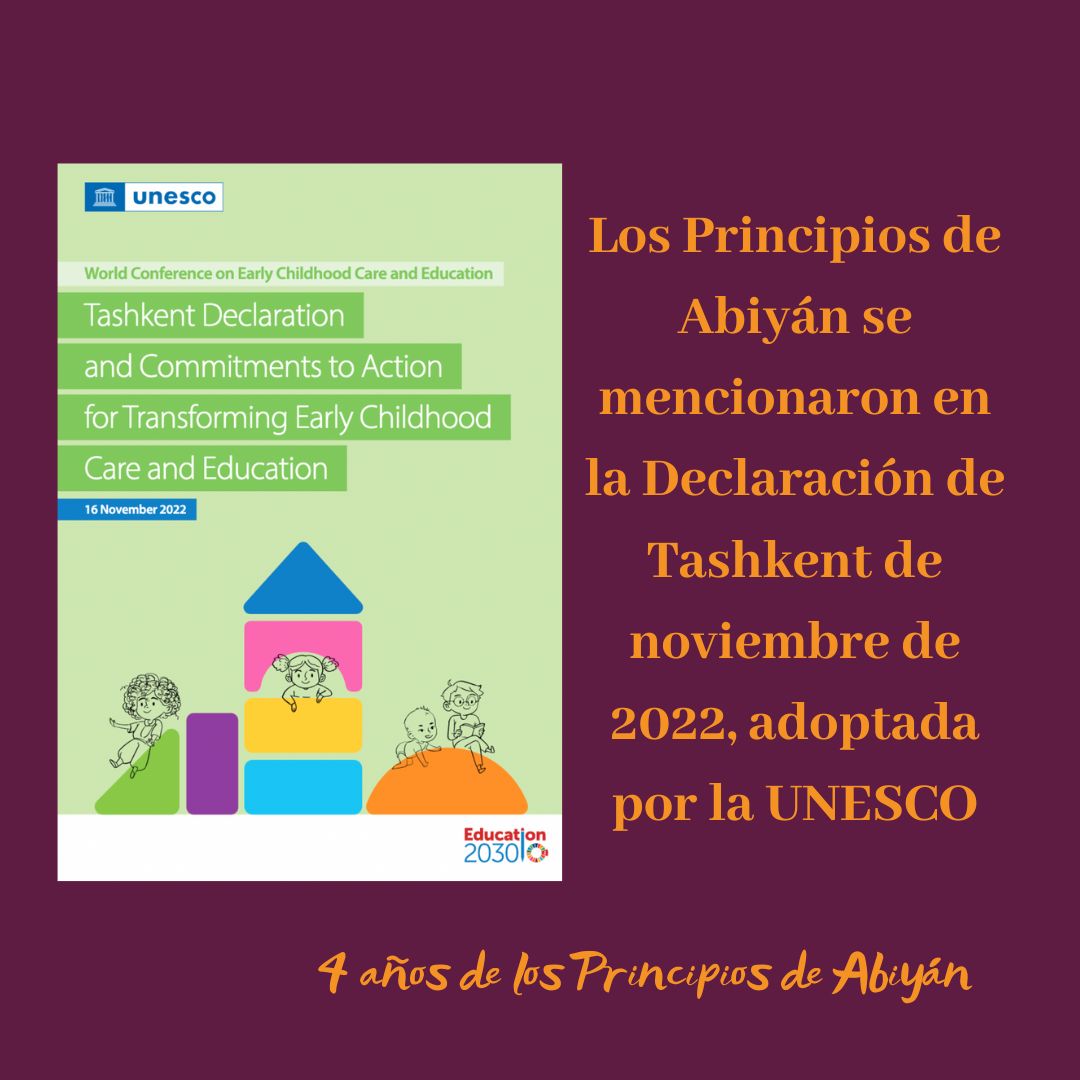
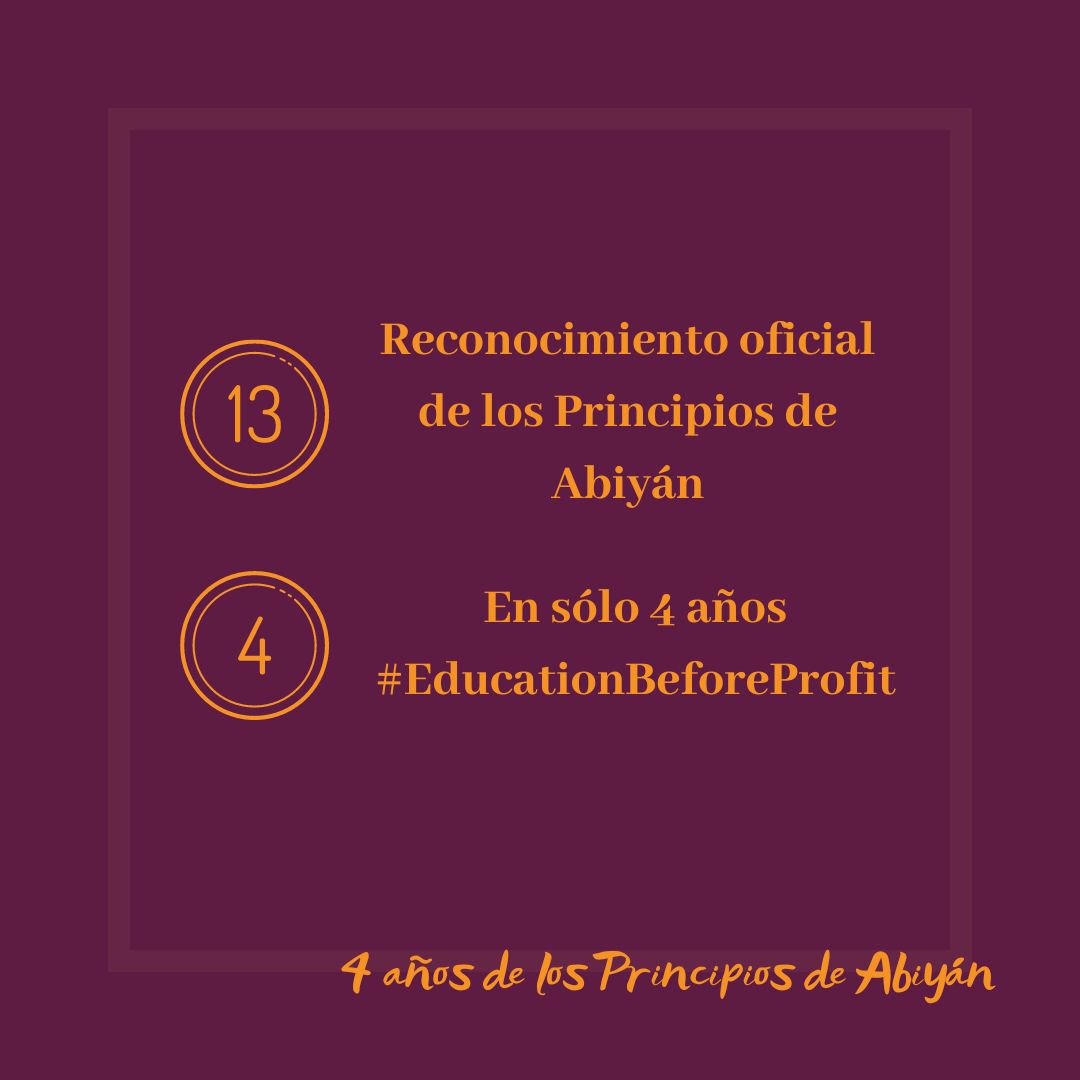
En tan solo cuatro años, los Principios han sido reconocidos por más de 10 organismos de derechos humanos e instituciones jurídicas. De igual manera, recientemente se hizo referencia a ellos en la Declaración de Tashkent, adoptada en la Conferencia Mundial de la UNESCO sobre Atención y Educación de la Primera Infancia (noviembre de 2022).
Hasta la fecha, los Principios de Abiyán han sido utilizados para la investigación, la promoción y el litigio por diversos actores de América del Sur, África, Europa y Asia. Además de los recursos que pueden encontrarse en el sitio web, en 2021 se publicó el libro "Realizing the Abidjan Principles on the Right to Education". El libro es de libre acceso y se publicó junto con una serie de vídeos en los que las autoras y los autores resumen sus capítulos.
A continuación se ofrece una visión general de algunos de los principales acontecimientos ocurridos desde junio de 2022, así como de los próximos eventos que tendrán lugar en los próximos meses.
Para más información, siga las novedades en el sitio web de los Principios de Abiyán y en Twitter con el hashtag #AbidjanPrinciples.
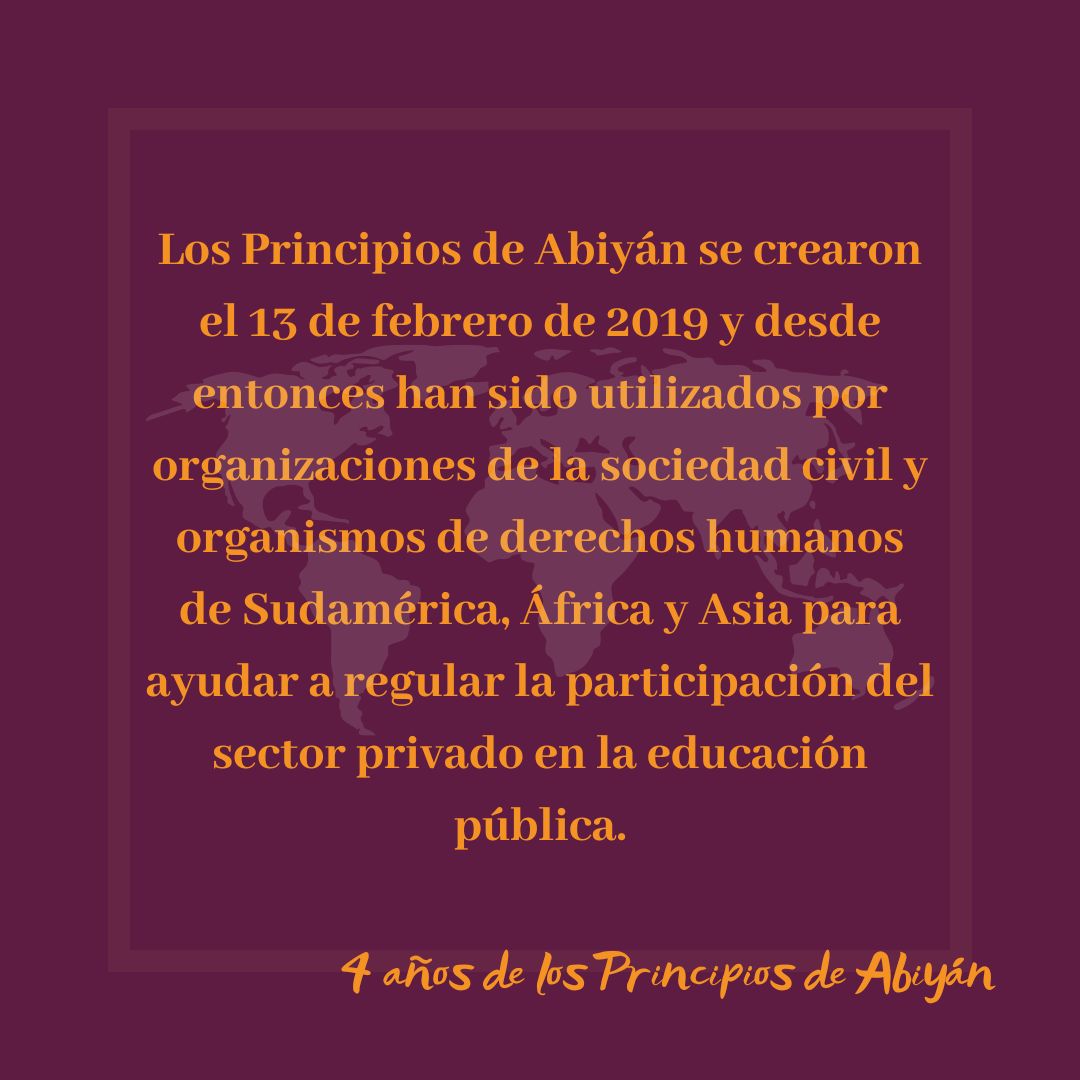
4º aniversario
La cuenta regresiva de cuatro días para el cuarto aniversario se ha puesto en marcha en Twitter e Instagram. A continuación se muestran algunas de las imágenes utilizadas en la celebración. ¡Por favor, únete en la celebración de los logros de los Principios de Abiyán mediante la publicación de estos mensajes en tus propias cuentas de redes sociales!
Únete a nosotras y nosotros: #AbidjanPrinciples
Copyright (C) 2021 Abidjan Principles. All rights reserved.
You are receiving this email because you opted in during a consultation on the Abidjan Principles or on the website www.abidjanprinciples.org.
