

Don´t miss any updates!

On the Ground
Explore our work with partners, globally and locally, to tackle social and economic injustice using a human rights lens.
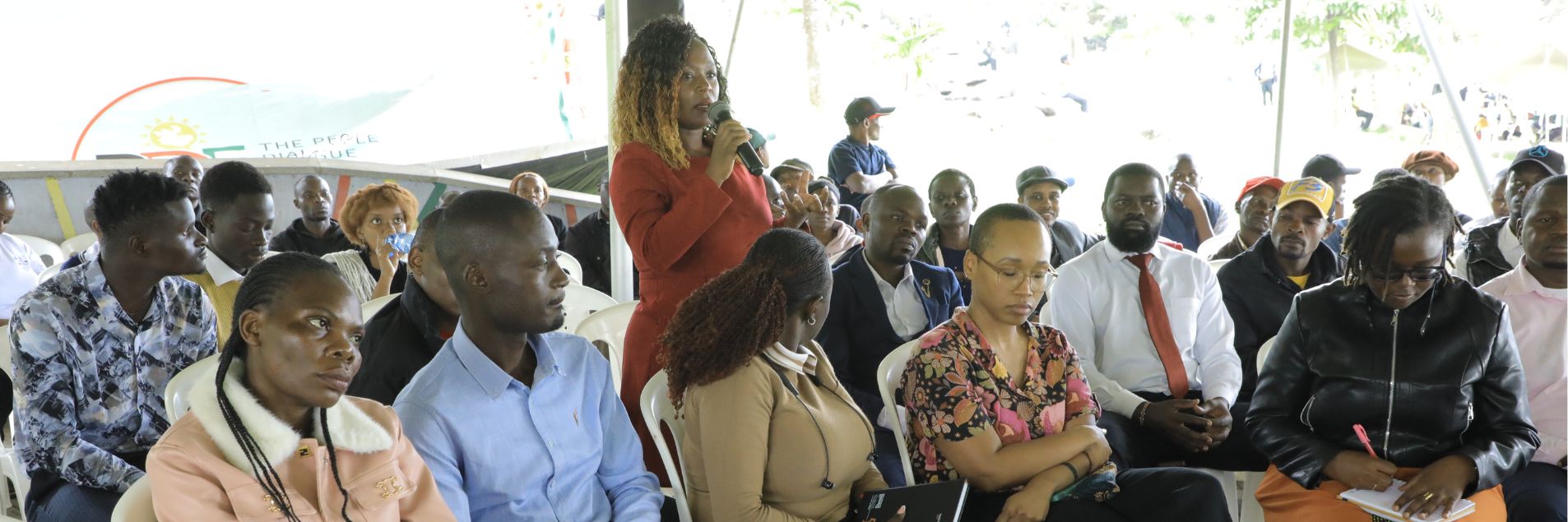
GI-ESCR at the People’s Dialogue Festival 2026
On 6 March 2026, GI-ESCR, in collaboration with Hakijamii and The Institute of Social Accountability (TISA), convened a breakaway session titled “Closer to the People? Rethinking Debt, Devolution and Accountability in ESC Rights” during the People Dialogue Festival 2026, which had the theme "Building a Collaborative Democracy for Kenya’s Sustainable Future.” The session provided a dedicated platform for advancing dialogue on economic, social, and cultural rights in Kenya. Something that has been missing in previous PDF sessions.
Designed as an interactive forum, the discussions aimed to deepen participants’ understanding of how governance systems, service delivery models, financing structures, and accountability mechanisms that shape the realisation of these rights, while elevating community perspectives and lived realities from the grassroots.
Key Discussions from the Panel
The session opened with Joakim Simiyu, the Secretary General of the Safina Party, who reminded participants that “Kenya does not have a money problem but a problem on how the money is spent,” encouraging participants to follow the money channels to hold elected leaders accountable.
Opening remarks were given by Diana Gichengo, the Executive Director at TISA, who also highlighted how debt affects the provision of ESC rights. “When people are dying because of a lack of food or hospitals without medicines. It would be immoral for the State to focus on debt repayment. The country's national interest should always be the people first.”
The panel sessions opened with Tom Ogada from TISA, who unpacked the implications of Kenya’s rising debt on the financing of ESC rights. He highlighted how growing debt obligations and political prioritisation of budget allocation risk constraining fiscal space for equitable public investment in critical sectors such as education, health, food security, and water and sanitation.
Turning to education financing, David Karani from the Elimu Bora Working Group, convened by the Kenya Human Rights Commission, highlighted that the discontinuation of the Edu Afya Programme has reduced students' access to healthcare services previously provided under the programme. The programme, which cost the government about Ksh. 4 billion annually, was discontinued without meaningful public participation. He further raised concerns about the deeper challenges of accountability and transparency in education financing, highlighting how governance gaps continue to directly affect students' access to quality education.
On the health sector and its financing, Vivian Ng’ang’a from the Institute of Public Finance (IPF) raised concerns about the adequacy and sustainability of Kenya’s health financing reforms under the Social Health Authority (SHA). She noted that while health is a devolved function and devolution has improved access to healthcare by bringing services closer to communities, persistent delays in the disbursement of funds from the National to the County government continue to undermine quality service delivery at the county level.
On the right to food, Eve Maathai from Budget Talk Global emphasised the need to move beyond recurring emergency responses to natural calamities and instead strengthen long-term resilience, climate adaptation, and accountability mechanisms that protect food security and livelihoods, particularly for vulnerable communities.
Issues of water and sanitation were highlighted by Fredrick Odhiambo from Hakijamii, who emphasised the responsibility of people to take care of their environment to support the integration of sustainable water and sanitation systems for all. He also highlighted the need for national and county governments to shift from reactive emergency aid to proactive climate-resilience.
The panel concluded with reflections on accountability mechanisms for the realisation of economic, social, and cultural rights. Roselyne Onyango from GI-ESCR highlighted regional and global accountability mechanisms for monitoring State compliance with economic, social, and cultural rights obligations, explaining how these processes operate and the avenues for public participation. Building on this, James Mwenda from the Kenya National Commission on Human Rights (KNCHR) emphasised that at the national level, the most fundamental accountability mechanisms remain the people themselves, through how they elect their leaders and hold them accountable using the Constitution and the oversight laws and policies available to them.

Participants Reflections and Recommendations
A central feature of the session was its interactive nature, with participants sharing reflections and recommendations grounded in lived experiences and community perspectives.
One key reflection raised a critical question: Are Kenyans unintentionally cushioning the government from pressure to deliver public services? While the State has the obligation to progressively realise ESC rights, many citizens have increasingly organised private alternatives to meet their needs. From enrolling children in private schools, to purchasing private health insurance, to organising for privatised water systems within residential estates, individuals and communities are often stepping in to fill gaps in the provision of public services. Participants and panellists alike questioned whether these coping mechanisms, while a personal choice, may inadvertently reduce pressure on the government to strengthen and adequately fund public systems.
Another concern raised during the discussions was that reporting does not automatically translate into accountability. While numerous reports document the misuse or mismanagement of public funds, participants noted that monitoring alone is insufficient. Accountability only becomes meaningful when findings lead to concrete action and when those responsible face real consequences.
Building on these reflections, participants proposed several recommendations. Among the key proposals was the idea of developing a People’s Manifesto on ESC rights to be presented to political aspirants ahead of the upcoming election cycle, ensuring that commitments to education, health, food, water, and other social rights are clearly reflected in political platforms.
Participants also emphasised the need to simplify discussion around public debt and fiscal policies to make them accessible to ordinary citizens. Strengthening public understanding, they argued, would empower communities to engage more meaningfully in governance and accountability processes.
The discussions further underscored the role of citizens and CSOs, through democratic participation and sustained civic engagement, in holding the State accountable for the realisation of social rights.
Looking Ahead
As Kenya moves closer to another election cycle, participants stressed the importance of sustained dialogue and collective advocacy to ensure that fiscal decisions and governance reforms prioritise the realisation of ECOSOC rights. The session reaffirmed the need for continued collaboration among civil society, government institutions, and communities to translate policy commitments into equitable access to essential services.
GI-ESCR and partners expressed commitment to building on the momentum generated during the session by advancing public awareness, strengthening accountability mechanisms, and fostering inclusive dialogue that keeps the realisation of social rights at the centre of Kenya’s development agenda.
To read more on the issues of debt and its impact on the Financing of Health and Education in Kenya, read our latest report here.
Related Articles
SITEMAP
TAKE ACTION
NEWSLETTER
