

Don´t miss any updates!

On the Ground
Explore our work with partners, globally and locally, to tackle social and economic injustice using a human rights lens.

Santa Marta’s Test: Turning Fossil Fuel Commitments into Rights-Based Action
Between 24 and 29 April, the First Conference on Transitioning Away from Fossil Fuels took place in Santa Marta, Colombia. The Conference, hosted by Colombia and the Netherlands, was set up in response to the lack of meaningful, implementation-oriented outcomes to give effect to the commitment of transitioning away from fossil fuels at the multilateral level. It also aimed to advance practical pathways for a just, orderly and equitable transition.
Read more here.
Throughout the Conference, we participated in debates and strategic spaces with feminists, civil society organisations, government representatives and other stakeholders, bringing a human rights and gender-just perspective to discussions on defossilisation to ensure that the transition is centred on the needs of people and planet. Our contributions highlighted the structural inequalities underpinning the climate emergency and strongly emphasised that any transition must be gender-just and care-centred.
We also joined collective civil society efforts to emphasise that any transition framework must be grounded in human rights, including the rights to participation, access to information and free, prior and informed consent. In this context, our interventions underscored the importance of ensuring the protection of environmental and land defenders and that affected communities can meaningfully engage in decision-making processes shaping the transition away from fossil fuels.
First Conference on Transitioning Away from Fossil Fuels
From 27 to 29 April, Colombia and the Netherlands hosted the two formal spaces of discussion that constituted the official Conference: the Assembly of the People and the High-Level Segment.
The Assembly of the People served as a forum to bring together feminists, social movements, groups, NGOs and other stakeholders and a space where the collective demands could be delivered into the formal process. The Assembly hosted a total of 250 participants, including 60 elected representatives from the movement-led People's Summit.
The High-Level Segment was the main space for debate among the States and deliberation. It included a series of dialogues, both in plenary and divided into working thematic sessions, around the three interconnected thematic pillars of the Conference:
- Overcoming economic dependence, recognising that many countries rely on fossil fuels for public revenues, employment, and broader economic activity.
- Transformation of both the supply and demand of fossil fuels.
- International cooperation and multilateralism, aiming to bridge existing gaps in governance and implementation, including limitations within the UNFCCC framework.
The participation of civil society was limited due to the bottleneck approach established by the hosts. During the Assembly of the Peoples, each of the chapters that civil society was divided into (NGOs, Women and Diversities, Social Movements, Afrodescendants, Indigenous Peoples, Farmers and Youth) elected representatives to attend the High-Level Segment. GI-ESCR's Programme Officer on Climate and Environmental Justice, Maggie Rochi, was elected to represent the Women and Diversities chapter. Representatives from Trade Unions, Academia, the Private Sector and Parliamentarians also participated.
The formal spaces of the Conference saw substantive debates, beyond the formal outcomes that came from the process. On the question of economic dependence on fossil fuels, discussions had a significant emphasis on moving from fiscal lock-in and debt-constrained fiscal space toward higher fiscal capacity, with concrete proposals including debt-for-climate swaps, progressive tax reform and strengthened oversight of fossil assets.
On supply and demand transformation, the discussions emphasised the need for a managed phase-down of fossil fuel extraction, clear policy signals and long-term planning, and the importance of community-led approaches and participation to build legitimacy for the transition. Similarly, the focus on energy access for rural, remote and marginalised communities, and the call for community-owned distributed renewable systems, reflects a commitment to ensuring the transition reaches everyone. However, there was a notable gap in discussions: care responsibilities and their centrality to a just transition were largely absent.
At the end of the Conference, Colombia and the Netherlands published the takeaways of the Conference. This document marks an important political step; it presents the imperative of the transition away from fossil fuels and highlights the commitment of a coalition of willing states, representing approximately one-third of global GDP, to move towards a fossil-free future. While recognising the current context of geopolitical instability and market volatility, the document goes further in considering the transition to be essential, not only for climate mitigation, but also for energy security and economic resilience. By doing so, it distances itself from the limited outcomes achieved within the UNFCCC process in recent editions, creating a political pathway for accelerated climate action.
The official document highlights five key outcomes of the meeting:
- The announcement of a second conference in 2027, to be co-hosted by Tuvalu and Ireland, signalling political continuity and suggesting that this process is intended to become a sustained platform for implementation.
- The establishment of a dedicated group to sustain momentum towards the second conference and strengthen connections with existing alliances and initiatives, while ensuring alignment with ongoing processes under the UNFCCC.
- The embedding of the Conference’s efforts within the broader multilateral ecosystem, with plans to formally channel its results into key political moments such as the Subsidiary Bodies’ session and upcoming climate weeks; an approach that seeks to both sustain momentum and amplify political visibility.
- The establishment of three thematic workstreams focused on identifying concrete opportunities and channels for cooperation to overcome fossil fuel dependencies. These workstreams aim to remain flexible and inclusive, enabling countries to engage according to their capacities and priorities while drawing on existing expertise.
- The launch of a Science Panel for the Global Energy Transition.
Santa Marta Must Strengthen the UNFCCC, Not Merely Become a Parallel Track
Tuvalu’s role as co-host carries strong symbolic and political weight. It also indicates that the next conference could be shaped by countries with high levels of ambition and a clear interest in translating commitments into concrete policies.
At the same time, both the second and third outcomes speak to one of the central tensions of the Santa Marta process: the relationship between this coalition of willing States and the broader multilateral system. While efforts such as Santa Marta can be powerful drivers of ambition, their impact ultimately depends on whether that ambition feeds back into more permanent frameworks or regimes. A coalition that advances bold positions outside the UNFCCC risks becoming a parallel track that empties the multilateral system rather than reinvigorates it, while not creating an effective replacement of the existing frameworks. A political convening is very different from a binding treaty, with clear legal obligations for States. For Santa Marta to fulfil its potential, the dedicated group must be a lever to push the UNFCCC and the Member States that have historically obstructed progress toward a fossil-free future. The value of a club of the willing will be to push the multilateral system to finally act.
Implementation Tools Must Reflect Rights, Care and Frontline Priorities
Regarding the three thematic workstreams, there is some concern regarding an overly economic and financial framing, risking the production of recommendations that are financially coherent but ignore the human rights implications of the transition. Their value will also depend on their design and analytical scope. Tuvalu’s role as co-host of the next conference could help ensure that they reflect the priorities of frontline communities and the Global South.
Lastly, the launch of a Science Panel for the Global Energy Transition places science at the centre of the process, helping to anchor decisions in pathways aligned with the 1.5°C goal and to address legal, financial and political barriers to transition. This is a welcome step, provided the Panel’s mandate is broad and inclusive. Science should not be reduced to technical or economic modelling; it must also include the social, gender and human rights dimensions of the transition. Otherwise, the Panel risks producing roadmaps that are technically sound but disconnected from realities on the ground. It will also be important to ensure coherence with other initiatives, such as the future Belém-Antalya Mechanism and the ILO Just Transition Gateway.
The Test Is Whether Santa Marta Can Shape Real Multilateral Action
The takeaways document also includes a Summary of discussions that reflects a meaningful step forward in building the shared understanding and political will needed to advance a just transition away from fossil fuels. Together, these discussions show that implementation depends on more than technical energy planning. It also requires fiscal capacity, public finance, participation, rights-based governance and international cooperation. Colombia and the Netherlands are expected to release a full co-host report of the Conference at London Climate Week, which will hopefully further develop the discussions that took place in Santa Marta. It will be key that these discussions find their way into formal UNFCCC processes, feeding into upcoming negotiations and contributing to the kind of ambitious, rights-based and gender-just outcomes that the climate emergency demands. Santa Marta has set an important precedent. Ensuring its findings carry weight in the multilateral arena will be key to translating this momentum into real policy change.
The People’s Summit for a Fossil-Free Future
The People’s Summit for a Fossil-Free Future was a civil-society-led space held from 24 to 26 April, prior to the official high-level segments of the Conference. It was organised to complement the Conference’s broader aim of moving from political commitments on transitioning away from fossil fuels towards practical pathways for implementation. The Summit served as a space for self-organised civil society to debate, consolidate common positions and unify demands ahead of the formal process, helping ensure that civil society perspectives could feed into discussions on a just, orderly and equitable fossil fuel phase-out.
Over the three days of the Summit, discussions were divided both in regional and sectoral discussions to come up with unified positions and select representatives who would deliver a common position at the Assembly of the People.
Among the demands that emerged during this process, there was a crucial call for a rapid, people-centred, gender-just and rights-based expansion of renewable energy (especially solar and wind), not merely to meet new demand but to actively replace fossil fuels and address energy poverty. They called for care-centred transition policies that recognise, revalue and equitably redistribute care work, guarantee universal quality services in health, education and care, and place social protection and community wellbeing at the heart of regenerative economies, advancing gender equality and women's rights across every dimension of the transition.
The space managed to build a unified position, to be delivered at the Assembly of the People, which was held on 27 April as part of the official process. During the Summit, regional leaders elected 60 representatives to join the Assembly of the People and bring civil society demands into the formal process.
Santa Marta showed the collective power that civil society has, both in mobilising for stronger climate action and in putting together the Summit itself. The work of civil society proved essential to overcome the difficulty of organising such a Conference on a short timeline, and despite the challenges faced by many colleagues to arrive in Santa Marta, the Summit guaranteed broader participation of stakeholders to guide the Conference towards higher ambition, ending with a Declaration that sets a roadmap towards a fossil-free future. In addition, the feminist and gender sector convening at the Summit, after months of work through written submissions and online dialogues, produced this collective statement detailing a feminist vision for the Conference.
Feminist Just Transition Mixer
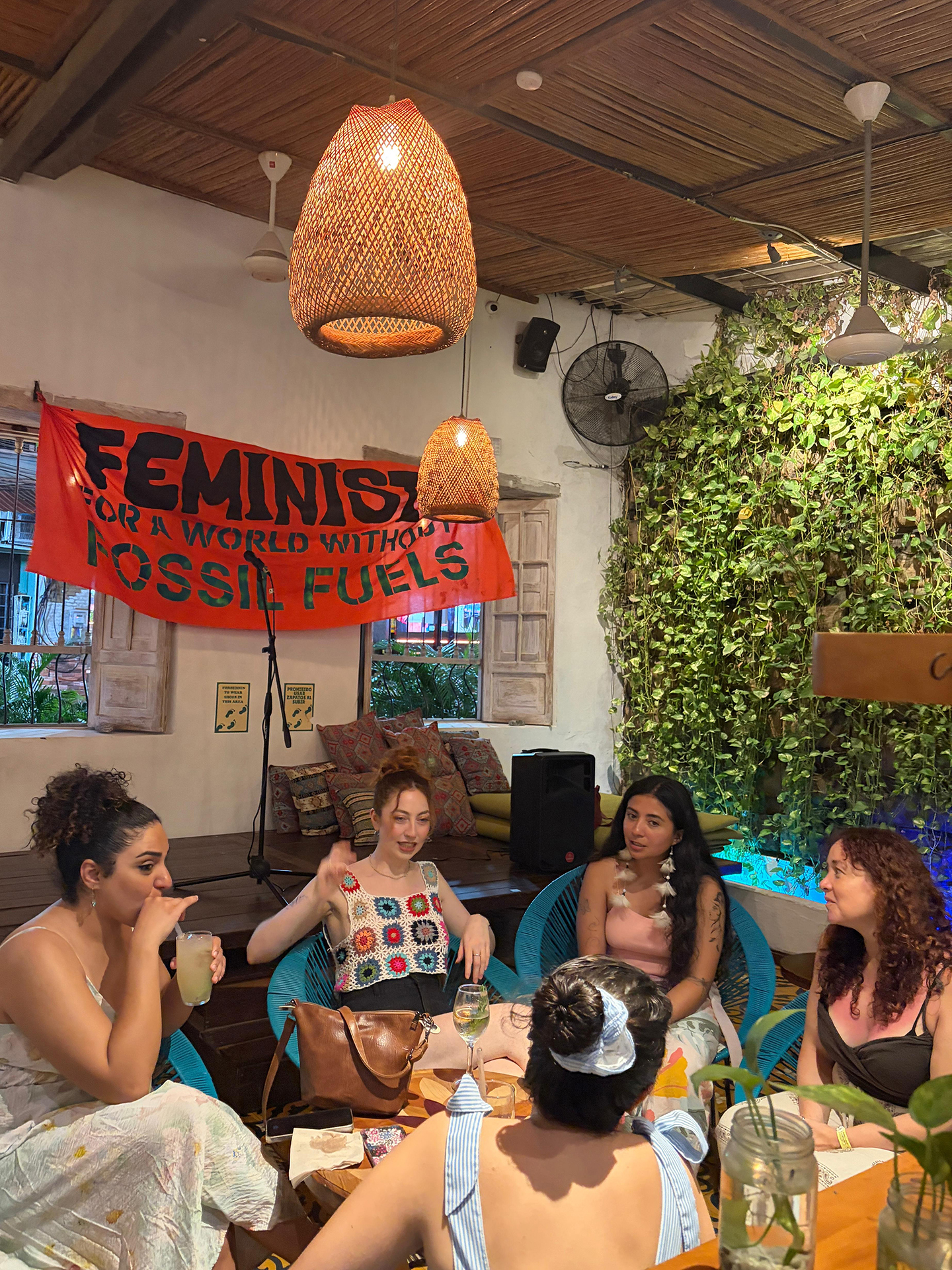
On 29 April, together with WEDO, WECF, WILPF, MENAFEM and LIMPAL Colombia, we hosted the Feminist Just Transition Mixer, a space intentionally designed for feminists and gender justice advocates to come together, connect and celebrate at the close of the Conference. After days of intense negotiations, panels and advocacy work, the Mixer offered a moment to pause, reflect and recognise the vital role that feminist movements play in advancing a just transition. It brought together activists, organisers and practitioners from across the globe, creating an atmosphere of solidarity, joy and shared purpose.


What Santa Marta Left Behind and What Comes Next for a Just Energy Transition in Latin America and the Caribbean
On 21 May, REDFIS, GFLAC, CANLA, CEDES, Argentina 1.5 and GI-ESCR held the webinar ‘Lo que dejó Santa Marta y lo que sigue para la transición energética justa en América Latina y el Caribe’ (‘What Santa Marta Left Behind and What Comes Next for a Just Energy Transition in Latin America and the Caribbean’).
Following the Santa Marta Conference, the discussion explored how the conversation on just transitions is entering a new phase: how to move beyond fossil fuels in the face of structural challenges such as debt, subsidies and financing gaps.
During the webinar, Maggie Rochi, our Programme Officer on Climate and Environmental Justice, joined the discussion on the key outcomes of Santa Marta, the gaps in the process and the road ahead for the climate justice agenda.
The online event offered a space for dialogue on the political, social and financial implications of the energy transition for Latin America and the Caribbean, a region with much at stake and much to contribute.
Watch the recording here: https://www.youtube.com/watch?v=EJaEChspXzM
Related Articles
SITEMAP
TAKE ACTION
NEWSLETTER
